> ## Documentation Index
> Fetch the complete documentation index at: https://docs.terminal3.io/llms.txt
> Use this file to discover all available pages before exploring further.
# Decentralized ID (DID)
> Decentralized Identities and their methods
Terminal 3 provides universal identities for both humans and AI agents based on W3C’s [Decentralized Identifiers (DID)](https://www.w3.org/TR/did-core/) global standard specs.
# What is a Decentralized Identifier (DID)?
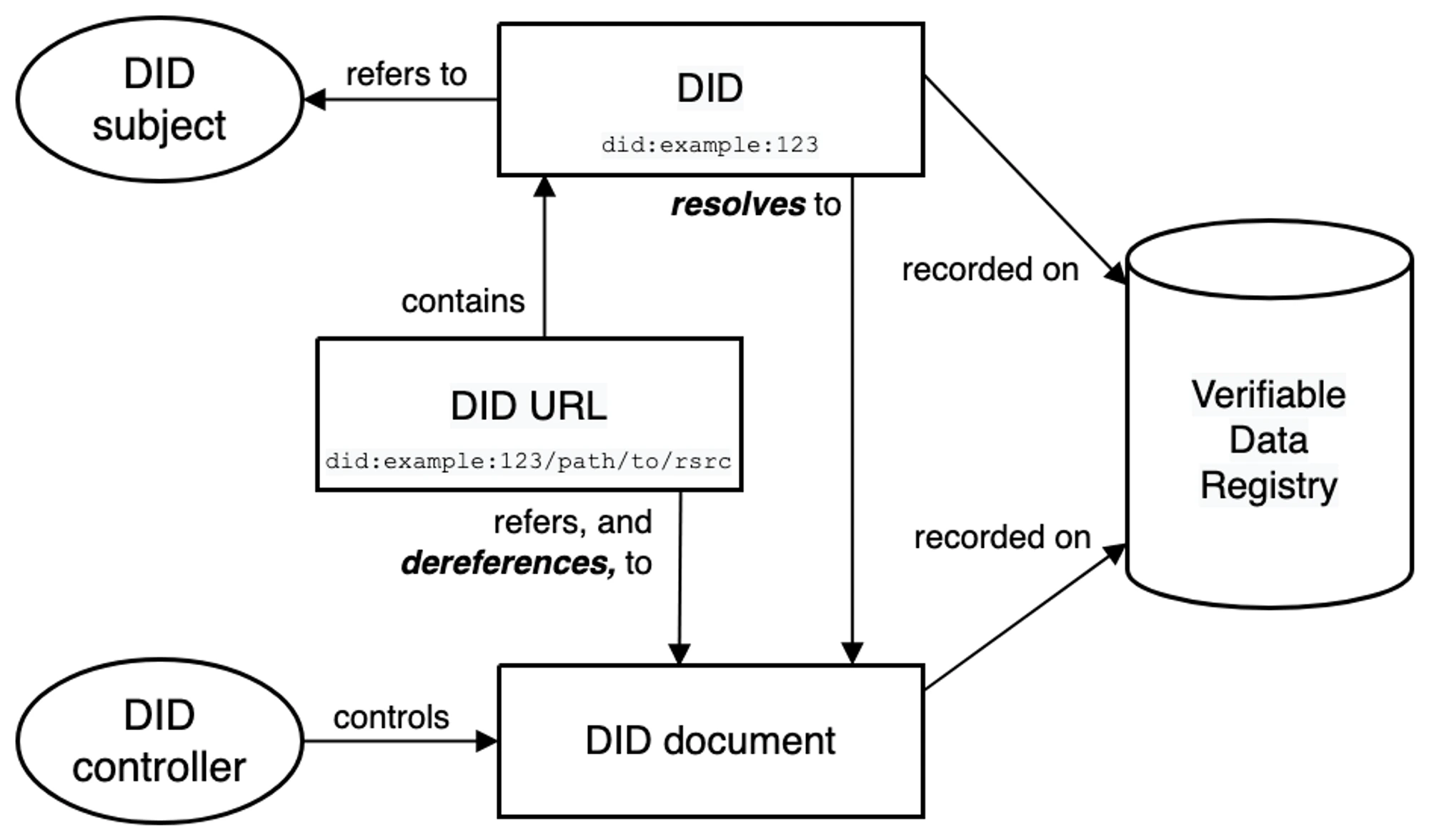
DIDs are identifiers that enable verifiable, decentralized digital identities. A DID refers to any subject (e.g. a person, group, organization, abstract entity, etc.) as determined by the controller of the DID.
Specifically, DIDs are [URIs](https://www.rfc-editor.org/rfc/rfc3986) (unique digital addresses) that associate a DID subject with a DID document allowing trustable interactions associated with that subject. Similar to a URL, when you resolve a DID, you receive a DID document in JSON, JSON-LD, or similar format.
## A simple DID example
A DID is a simple unique text string consisting of three parts:
1. the `did` URI scheme identifier;
2. the identifier for the DID method; and
3. the DID method-specific identifier.
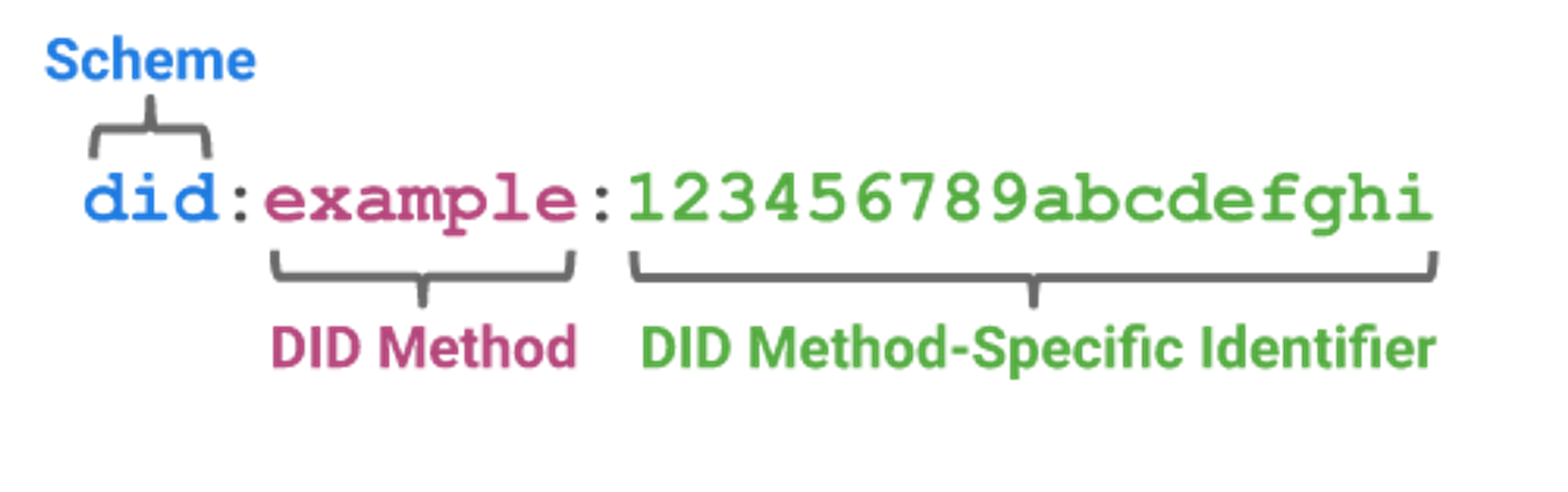 The example DID above resolves to a DID document.
## **Multiple DIDs**
A subject may have as many DIDs as they want for different use cases, such as:
* a DID for educational certificates; or
* a DID for verified identity / KYC documents; or
* a DID for online gaming accounts.
# What is a DID Document?
A DID document contains information associated with the DID, such as ways to cryptographically authenticate a DID controller.
```json theme={null}
{
"@context": [
"https://www.w3.org/ns/did/v1",
"https://w3id.org/security/suites/ed25519-2020/v1"
]
"id": "did:example:123456789abcdefghi",
"authentication": [{
"id": "did:example:123456789abcdefghi#keys-1",
"type": "Ed25519VerificationKey2020",
"controller": "did:example:123456789abcdefghi",
"publicKeyMultibase": "zH3C2AVvLMv6gmMNam3uVAjZpfkcJCwDwnZn6z3wXmqPV"
}]
}
```
# DID Methods
A DID method (and its spec) defines the precise operations by which DIDs and DID documents are created, resolved, updated, and deactivated.
There are currently more than [150](https://www.w3.org/TR/did-spec-registries/#did-methods) DID methods out there, which can be categorized into 4 main types based on their **storage method**:
* Centralized: relies on a Web2 server
* Blockchain-based: the “original” DID method involving a blockchain
* Hybrid: uses decentralized storage to store its documents
* Static: no data registry is required; can be created and resolved by encoding/decoding data directly.
Terminal 3 currently provides a custom `did:t3n` DID.
| | Centralized | Blockchain-based | Hybrid | Static |
| ------------------------- | ---------------------------------------- | ---------------------------------------- | ---------------------------------------- | -------------------- |
| Privacy | low | high | high | medium |
| Self-Sovereign? | no | yes | yes | yes |
| Data Registry Required? | yes | yes | yes | no |
| (web2 server) | yes | | | |
| (Blockchain) | | yes | yes | |
| (L2 storage) | | | yes | |
| Decentralized? | no | yes | yes | yes |
| Complexity | simple | complex | medium | simple |
| Transaction Fee Required? | no | yes | yes | no |
| (when updating) | | | yes | |
| Mutable? | yes | no | no | no |
| Supported Operations | create
The example DID above resolves to a DID document.
## **Multiple DIDs**
A subject may have as many DIDs as they want for different use cases, such as:
* a DID for educational certificates; or
* a DID for verified identity / KYC documents; or
* a DID for online gaming accounts.
# What is a DID Document?
A DID document contains information associated with the DID, such as ways to cryptographically authenticate a DID controller.
```json theme={null}
{
"@context": [
"https://www.w3.org/ns/did/v1",
"https://w3id.org/security/suites/ed25519-2020/v1"
]
"id": "did:example:123456789abcdefghi",
"authentication": [{
"id": "did:example:123456789abcdefghi#keys-1",
"type": "Ed25519VerificationKey2020",
"controller": "did:example:123456789abcdefghi",
"publicKeyMultibase": "zH3C2AVvLMv6gmMNam3uVAjZpfkcJCwDwnZn6z3wXmqPV"
}]
}
```
# DID Methods
A DID method (and its spec) defines the precise operations by which DIDs and DID documents are created, resolved, updated, and deactivated.
There are currently more than [150](https://www.w3.org/TR/did-spec-registries/#did-methods) DID methods out there, which can be categorized into 4 main types based on their **storage method**:
* Centralized: relies on a Web2 server
* Blockchain-based: the “original” DID method involving a blockchain
* Hybrid: uses decentralized storage to store its documents
* Static: no data registry is required; can be created and resolved by encoding/decoding data directly.
Terminal 3 currently provides a custom `did:t3n` DID.
| | Centralized | Blockchain-based | Hybrid | Static |
| ------------------------- | ---------------------------------------- | ---------------------------------------- | ---------------------------------------- | -------------------- |
| Privacy | low | high | high | medium |
| Self-Sovereign? | no | yes | yes | yes |
| Data Registry Required? | yes | yes | yes | no |
| (web2 server) | yes | | | |
| (Blockchain) | | yes | yes | |
| (L2 storage) | | | yes | |
| Decentralized? | no | yes | yes | yes |
| Complexity | simple | complex | medium | simple |
| Transaction Fee Required? | no | yes | yes | no |
| (when updating) | | | yes | |
| Mutable? | yes | no | no | no |
| Supported Operations | create
read
update
delete | create
read
update
delete | create
read
update
delete | create
read |
| Example | did:web | did:ethr
did:btcr
did:dock | did:3
did:ion
did:elem | did:key
did:pkh |
# DID System Architecture
### Generic DID Architecture